



Mānuka honey for skin health
Most people discover mānuka honey through wellness, as a sore throat remedy or an immune booster. And that reputation is well-earned. But where it really shines is skin health. It's an all-natural ingredient backed by clinical research, working with your skin to calm inflammation, support barrier function, and rebalance your microbiome. As an herbalist and biologist, that intersection is what drew me to mānuka honey in the first place, an ingredient rooted in traditional use that holds up under scientific scrutiny. I'll explain what it actually does at the skin level, how it works, and why it's earned so much attention in the skincare world.
A Little History
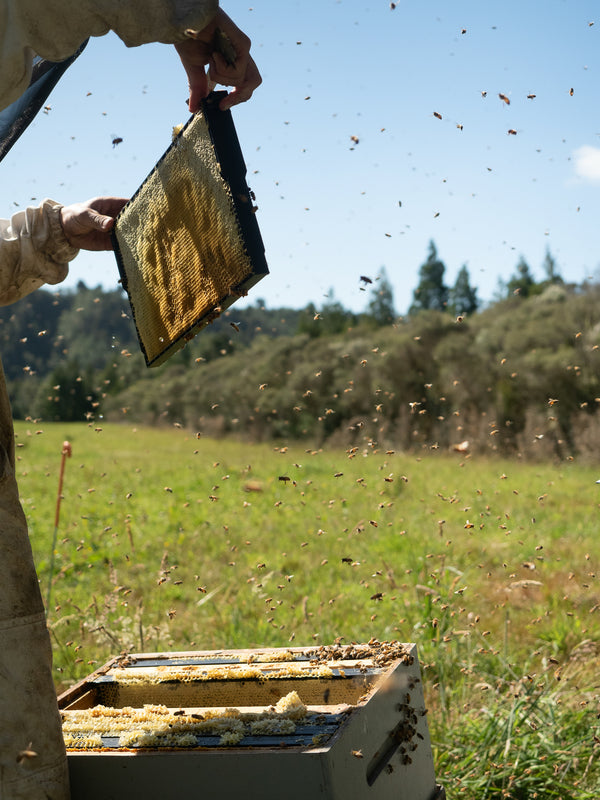
Honey has been used for skin and wound care for thousands of years. Ancient Egyptians, Greeks, and traditional healers across cultures all recognized that honey had properties that supported skin health and healing.
What's relatively new is our understanding of why mānuka honey, specifically, stands apart.
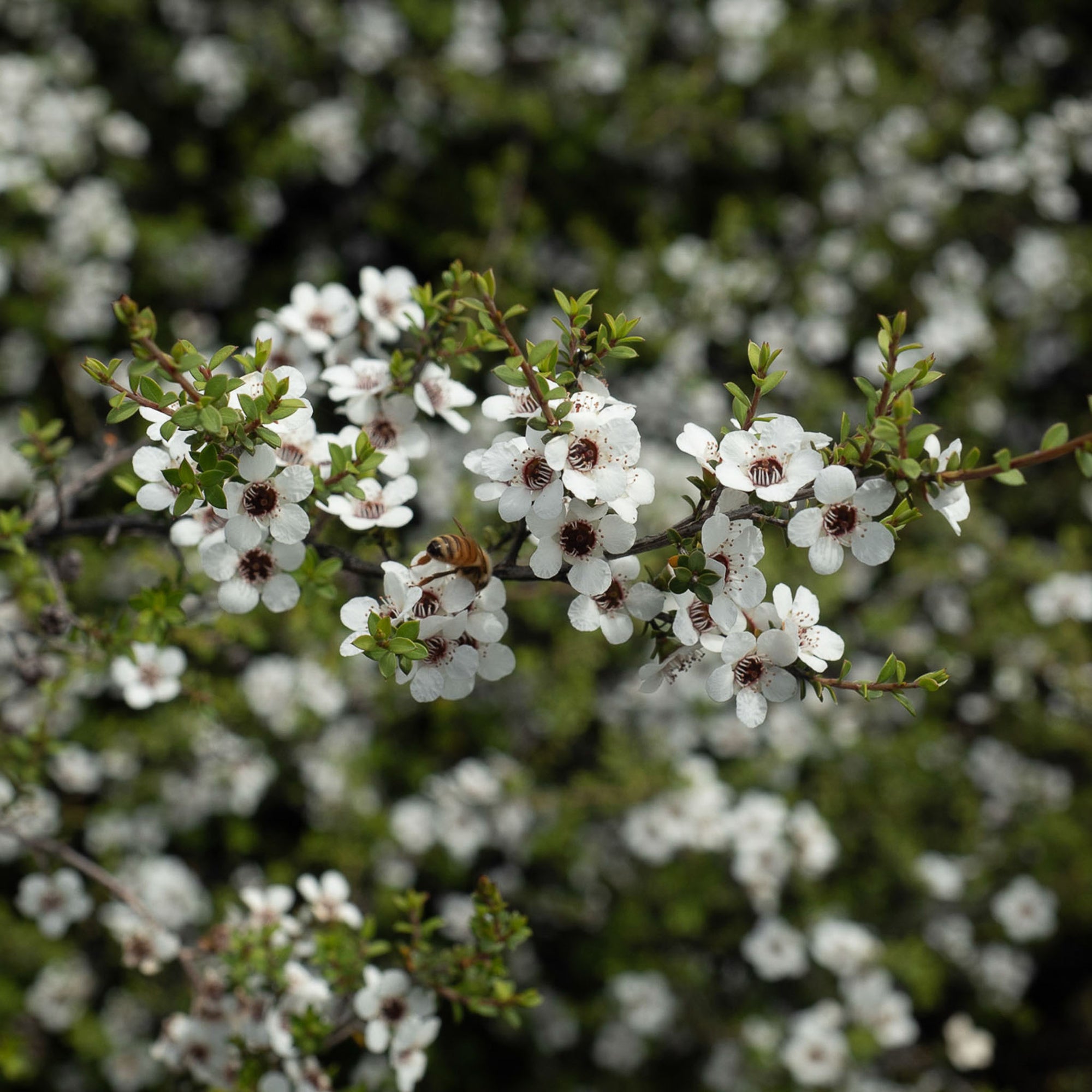
Mānuka honey comes from bees that pollinate the Leptospermum scoparium bush, which is native to New Zealand. The mānuka tree blossoms for a very short window, typically just two to six weeks per year depending on the region and weather conditions. That's it. If the conditions aren't right, or if rain washes the nectar away during that window, the yield drops dramatically.
This is a big part of why mānuka honey is so expensive. Only about 2,800 tonnes of mānuka honey are produced annually, compared to roughly 1.9 million tonnes of other honey types globally. The supply is genuinely limited, and it can't be rushed or scaled the way other ingredients can.

What Makes Mānuka Different From Other Honey
All honey has some level of antibacterial activity. Studies have shown that in most honeys, this comes from peroxide activity, meaning the honey produces small amounts of hydrogen peroxide through an enzyme called glucose oxidase. The thing about peroxide activity is that it's fragile. Once honey is exposed to skin, air, heat, or light, that hydrogen peroxide breaks down and the antibacterial benefit diminishes quickly. So the antibacterial activity of regular honey is real, but it doesn't hold up well in real-world conditions.
Mānuka honey is different because its primary antibacterial power comes from a non-peroxide pathway. The key compound is methylglyoxal, or MGO, which is present thanks to the high levels of dihydroxyacetone naturally found in mānuka flower nectar. MGO exists in trace amounts in most honeys, but mānuka contains 40 to 100 times more of it.
In 1991, Professor Peter Molan at the University of Waikato demonstrated something that really set mānuka apart: when hydrogen peroxide was removed from a range of New Zealand honeys, the only honey that retained its full antibacterial activity was mānuka. Every other honey lost its effectiveness. Mānuka kept all of it. That study confirmed that mānuka's antibacterial properties come from a completely different mechanism than other honeys, and that mechanism, the non-peroxide activity driven by MGO, is stable. It doesn't degrade with exposure. It actually becomes more stable over time.
But MGO is only one piece. Mānuka honey contains a complex mix of bioactive compounds including polyphenols, flavonoids, organic acids, amino acids, enzymes, and natural humectants. It's rich in antioxidants like phenolic compounds, vitamin C, and catalase. These compounds work together, not in isolation, which is part of what makes mānuka so effective as a whole ingredient rather than a single extracted compound.
Understanding the Label
Transparency matters here, because it can be overwhelming to navigate mānuka honey as a consumer. There are several rating systems on the market, and understanding what they actually measure helps you make an informed choice.
What to Look for in Products
When you're evaluating a product that contains mānuka honey:
Check the ingredient list position. Ingredients are listed by concentration. If mānuka honey is near the bottom, you're getting a trace amount. For meaningful activity, it should be in the top third of the list.
Look for a UMF or MGO rating. If the product doesn't specify one, the mānuka concentration is likely too low to certify, or it may not be genuine mānuka at all.
Consider the price. Genuine UMF 15+ monofloral mānuka is expensive to source because of the limited annual harvest. If a product feels surprisingly affordable, that's worth questioning.
Mānuka's Fingerprint
Leptosperin is a compound found only in mānuka flower nectar. It can't be synthesized or added artificially. When a honey has verified leptosperin levels, you know it actually came from the mānuka bush. This is why UMF is generally considered the more reliable standard. It verifies authenticity alongside potency, while an MGO rating alone confirms methylglyoxal content but doesn't prove the honey is genuinely mānuka.

UMF Rating
UMF stands for Unique Mānuka Factor, and it's a more comprehensive grading system. UMF tests for four markers: methylglyoxal (potency), leptosperin (authenticity), DHA or dihydroxyacetone (shelf life stability), and HMF or hydroxymethylfurfural (freshness).
- UMF 5+: Low grade. Minimal therapeutic value for skin.
- UMF 10+ (roughly MGO 263+): Moderate. Some benefit, but below the therapeutic threshold for most skin applications.
- UMF 15+ (roughly MGO 514+): Therapeutic activity begins in earnest for skin health.
- UMF 20+ (roughly MGO 829+): Strong therapeutic activity. The range where research is most robust.
- UMF 25+: Maximum potency. Often more than what's needed for topical use.
MGO Rating
The MGO number tells you exactly how much methylglyoxal is in the honey, measured in milligrams per kilogram. This is the compound responsible for mānuka's non-peroxide antibacterial and antioxidant activity.
- MGO 83+: Entry level. Present, but minimal antibacterial activity for skin applications.
- MGO 263+: Moderate activity. Research begins to show measurable benefits at this range.
- MGO 514+: Strong antibacterial and antioxidant activity. Well-supported by studies for skin health applications.
- MGO 829+: Very high potency. Effective, but the incremental benefit for topical skincare becomes marginal at this level, and the cost increases significantly.
Monofloral vs. Multifloral
You'll also see these terms on labels.
Monofloral mānuka honey comes predominantly from mānuka flower nectar. It has higher concentrations of MGO, leptosperin, and the other signature compounds. This is what you want for skin health applications.
Multifloral mānuka honey is a blend where bees have collected nectar from mānuka and other flower sources. It still contains some mānuka compounds, but at lower concentrations. It's less expensive but also less potent.
For skincare purposes, monofloral is the standard worth looking for.
Allergies beware
If you're allergic to bee products, mānuka honey isn't for you. And if you're dealing with a severe flare or active skin infection, see your dermatologist before adding anything new.

Experience it yourself
Mānuka honey has thousands of years of traditional use behind it and a growing body of modern research to back it up. It's one of the few ingredients that's genuinely multifunctional: antibacterial without disrupting your microbiome, hydrating without heaviness, immunomodulatory in a way that calms overreactive skin without weakening its defenses, and supportive of your skin's natural repair and healing processes.
Whether your skin is out of balance, sensitive, eczema-prone, or breakout-prone, this is an ingredient worth understanding. The key is making sure you're getting the real thing, at a concentration that matters, in a formulation that puts it to work.
If you don't want to sort through labels and guess whether a product has enough mānuka to actually do something, our Discovery Set is a good place to start. It's small versions of our core mānuka-based formulas so you can try them on your skin without committing to full sizes..
Learn more -
View all-

Manuka Honey for Skin: What 6 Clinical Studies ...
Mānuka honey has been used on skin for centuries, but "traditional use" and "clinical evidence" are different things. If you're spending money on mānuka honey skincare, you deserve to know...
Manuka Honey for Skin: What 6 Clinical Studies ...
Mānuka honey has been used on skin for centuries, but "traditional use" and "clinical evidence" are different things. If you're spending money on mānuka honey skincare, you deserve to know...
-

Do You Really Need to Double Cleanse? A Herbali...
Do you really need to double cleanse? Skincare Herbalist and Apo.Ge founder & formulator Colleen Poe shares when it helps, when you can skip it, and how to find the...
Do You Really Need to Double Cleanse? A Herbali...
Do you really need to double cleanse? Skincare Herbalist and Apo.Ge founder & formulator Colleen Poe shares when it helps, when you can skip it, and how to find the...
-

Mānuka Honey & Hemp: The Best Natural Moisturiz...
Mānuka honey has a comedogenic rating of 0–1, making it one of the least pore-clogging natural ingredients available. Unlike coconut oil (comedogenic rating 4) or cocoa butter (rating 3–4), mānuka...
Mānuka Honey & Hemp: The Best Natural Moisturiz...
Mānuka honey has a comedogenic rating of 0–1, making it one of the least pore-clogging natural ingredients available. Unlike coconut oil (comedogenic rating 4) or cocoa butter (rating 3–4), mānuka...


