
Mānuka honey has real, peer-reviewed evidence supporting its use on skin. A gold-standard clinical trial showed significant improvement for eczema. A systematic review of 32 studies confirmed consistent antimicrobial activity against skin infection bacteria, including MRSA. The active compound, methylglyoxal (MGO), disrupts bacterial reproduction and stimulates your skin's own healing processes. Below, we break down five studies and explain what they found in plain language.
Mānuka honey has been used on skin for centuries, but "traditional use" and "clinical evidence" are different things. If you're spending money on mānuka honey skincare, you deserve to know what the research actually shows.
We went through the peer-reviewed literature and pulled five studies published in real journals, each reviewed by other scientists before going to print. Here's what they found, explained in plain language, with honest notes about where the science is strong and where it's still catching up.
The strongest evidence: a clinical trial on eczema
The most rigorous study we found was a 2017 randomized controlled trial published in Immunity, Inflammation and Disease (PMC5418133). An RCT is the gold standard in clinical research because it uses real patients, controlled conditions, and measurable outcomes.
Researchers recruited adults with atopic dermatitis (eczema) and applied mānuka honey to affected skin on one side of the body for seven consecutive nights. The other side served as a control. The treated side showed significantly lower severity scores (p<0.001), which isn't a marginal improvement, it's a statistically meaningful difference.
The study also revealed two things that matter for understanding how mānuka honey works on skin. It reduced inflammatory signaling (specifically IL-4 pathways) in skin cells, and it reduced Staphylococcus aureus bacteria on treated areas. S. aureus is one of the bacteria that makes eczema flare worse, so reducing it helps break the inflammation cycle.
Three of the 14 patients reported overall improvement in their eczema at a one-year follow-up. That's a small sample, yes. But this wasn't a lab dish. These were real people with a real skin condition, and they were still seeing results a year later.
What 32 studies say about mānuka honey and bacteria
A 2020 systematic review published in Antibiotics (PMC7693943) pulled together findings from 32 separate studies on mānuka honey and antibiotic-resistant infections. The picture is consistent: mānuka honey shows antimicrobial activity against bacteria that commonly cause skin infections, including S. aureus and MRSA.
There's an important caveat here. Most of these 32 studies were conducted in vitro, which means in a lab and not on human skin. Lab results tell you that the compound can affect bacteria under controlled conditions, but they don't automatically tell you what happens when you apply it to a living, complex skin ecosystem.
Still, the consistency matters. Across dozens of studies, different research teams, and different methodologies, mānuka honey keeps showing up with measurable antimicrobial effects.
How mānuka honey actually works on skin
A comprehensive review published in the International Journal of Dermatology in 2024 (Wiley) helps explain the mechanisms behind what other studies observe.
Methylglyoxal (MGO) is the compound that makes mānuka honey different from regular honey. Every honey has some antimicrobial activity through hydrogen peroxide, but mānuka honey has that plus MGO, which works through a completely separate pathway.
Here's what the review found about how MGO works. It disrupts bacterial cell division by attacking proteins that bacteria need to reproduce. Specifically, it targets arginine residues in bacterial collagen and interferes with autolysin, an enzyme bacteria use to split into new cells. Gram-positive bacteria (the kind most associated with skin infections) are particularly susceptible to this disruption.
Beyond fighting bacteria, mānuka honey stimulates your skin's own healing processes. It prompts macrophages (your immune cells) to release cytokines that trigger tissue repair and keratinocyte migration. In simpler terms, it helps your skin rebuild itself faster while it calms the inflammation that was slowing healing down.
The FDA approved MGO as a recommended wound treatment alternative in 2007. That approval is for wound care specifically, not cosmetic skincare, but it tells you the compound has been evaluated at a regulatory level and found effective enough to recommend in clinical settings.
New to mānuka honey skincare?
The Discovery Set gives you trial sizes of every Apo.Ge product, all formulated with 510+ MGO mānuka honey. It's the easiest way to find out what your skin responds to before committing to full sizes.
Understanding UMF and MGO ratings
If you've shopped for mānuka honey, you've probably seen numbers like "UMF 15+" or "MGO 514" on the label and wondered what they mean. These ratings measure the honey's potency, but they do it in different ways.
MGO stands for methylglyoxal, the bioactive compound responsible for mānuka honey's distinctive antimicrobial properties. When you see "510+ MGO" on a label, it means the honey contains at least 510 milligrams of methylglyoxal per kilogram. The higher the number, the more bioactive the honey is. Regular honey contains almost no MGO. Mānuka honey can range from under 100 MGO (low potency) to over 800 MGO (very high potency), and the concentration directly determines how effectively it fights bacteria and supports skin healing.
UMF stands for Unique Mānuka Factor, and it's a grading system developed in New Zealand that measures several compounds at once. A UMF rating tests for MGO, leptosperin (a marker that confirms the honey genuinely comes from mānuka flowers), and hydroxymethylfurfural (HMF, an indicator of freshness and quality). So while MGO tells you about one specific compound, UMF gives you a broader picture of authenticity and overall quality.
The two scales correlate directly. UMF 15+ corresponds to roughly 510+ MGO, and that's the range where clinical studies show meaningful antimicrobial activity. Below UMF 10 (or roughly 260 MGO), the honey still has some bioactive properties, but the concentration may not be high enough to deliver the results you see in the research.
This matters because not all mānuka honey skincare is created equal. A product using low-grade mānuka honey (under 100 MGO) contains significantly less methylglyoxal than one using medicinal-grade honey. Every Apo.Ge product uses mānuka honey rated 510+ MGO / 15+ UMF because that's the concentration range the clinical studies support. The grade isn't a marketing number, it's a measure of how much of the active compound is actually in the product.
The broader picture: honey and skin conditions
Two older studies round out the evidence base.
A 2003 study published in Complementary Therapies in Medicine tested a mixture of honey, beeswax, and olive oil on atopic dermatitis patients who were not using corticosteroids. Eighty percent of participants saw symptom improvement compared to a Vaseline control group. The formulation wasn't pure mānuka honey, but it demonstrates that honey-based topical treatments have been showing results in controlled settings for over two decades.
A 2017 review in the Central Asian Journal of Global Health (PMC5661189) traced honey's use for skin conditions across Persian, Ayurvedic, and Quranic traditional medicine systems. This isn't just historical curiosity. When multiple independent medical traditions arrive at the same application for the same ingredient over centuries, modern science pays attention. The review confirmed antimicrobial activity against skin-relevant microbes, immune modulation effects, and clinical evidence for burn wound healing.
What about acne specifically?
This is where honesty matters most.
A 2015 randomized controlled trial published in BMJ Open (PMC4746462) tested honey added to antibacterial soap for acne treatment, and the result was not positive. Honey did not show significant benefit over soap alone.
But two critical details change how you should interpret that finding.
First, the study used kanuka honey, not mānuka honey. Kanuka (Kunzea ericoides) and mānuka (Leptospermum scoparium) are different plant species native to New Zealand, and they produce honeys with different bioactive profiles. MGO, the compound responsible for mānuka honey's distinctive antimicrobial activity, is not present in significant quantities in kanuka honey.
Second, acne involves specific pathogenic pathways. The researchers themselves noted that honey's antimicrobial properties may not target the particular mechanisms that drive acne, primarily Cutibacterium acnes living deep inside clogged pores. The antibacterial activity mānuka honey demonstrates against surface bacteria like S. aureus is well-documented, but whether that translates directly to acne reduction is a different question that clinical trials haven't answered definitively yet.
We include this study because pretending it doesn't exist would be dishonest. The evidence for mānuka honey and eczema is strong. The evidence for mānuka honey and acne is more limited and indirect. What we know is that mānuka honey calms inflammation, supports barrier repair, and fights surface bacteria, and those are all things that help acne-prone skin function better. But "helps the conditions around acne" and "treats acne" are different claims, and we're careful about the distinction.
For acne-prone and sensitive skin
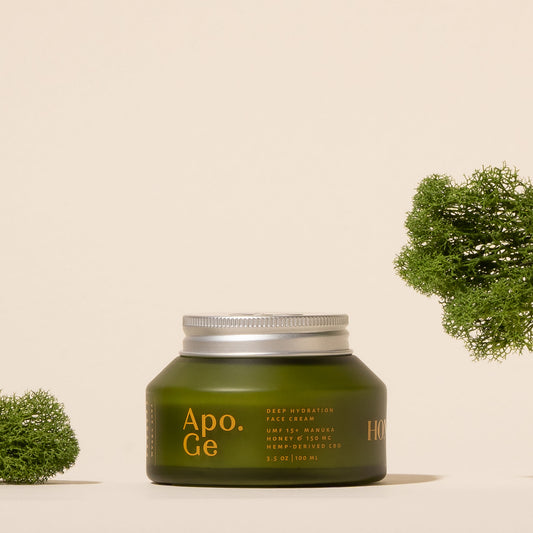
Our Deep Hydration Face Cream pairs 510+ MGO mānuka honey with niacinamide (Vitamin B3), kelp bioferment, and glycerine. It calms inflammation and reduces breakouts without stripping your skin's natural barrier.
Why we built Apo.Ge around this ingredient
Colleen is a biologist and certified herbalist. She reads these studies and understands the mechanisms at a molecular level. She chose mānuka honey as Apo.Ge's foundation not because it's trendy, but because the evidence supports what traditional medicine has known for centuries: this compound works with your skin, not against it.
The choice to pair mānuka honey with barrier-supportive ingredients like ceramides, niacinamide (Vitamin B3), and cold-pressed seed oils comes from the same research-informed approach. If mānuka honey calms inflammation and fights bacteria, and ceramides rebuild the protective lipid barrier, and niacinamide regulates oil production, then a formulation combining all three addresses acne-prone and sensitive skin from multiple angles simultaneously. That's not marketing logic, that's formulation science.
The bottom line
The research on mānuka honey and skin is real, growing, and encouraging. The strongest evidence is for eczema and atopic dermatitis, where a gold-standard clinical trial showed significant improvement. The antimicrobial evidence is consistent across dozens of studies, though it's mostly from laboratory settings. The mechanisms are well-understood and continue to be validated by new research.
Is it a miracle ingredient? No, and nothing is. But mānuka honey has something most trending skincare ingredients don't: a genuine body of peer-reviewed evidence showing how it works and why it works.
If your skin is sensitive, inflamed, or struggling with breakouts, the science says mānuka honey is worth your attention. We built an entire skincare line around it, and the research is one of the reasons why.
Sources
- Al-Waili NS. (2003). Topical Application of Natural Honey, Beeswax and Olive Oil Mixture for Atopic Dermatitis or Psoriasis. Complementary Therapies in Medicine.
- Alangari AA, et al. (2017). Honey Is Potentially Effective in the Treatment of Atopic Dermatitis: Clinical and Mechanistic Studies. Immunity, Inflammation and Disease. PMC5418133
- Nolan VC, et al. (2020). Clinical Significance of Manuka and Medical-Grade Honey for Antibiotic-Resistant Infections: Systematic Review. Antibiotics. PMC7693943
- Honey Therapies for Dermatological Disorders. (2024). International Journal of Dermatology. Wiley
- Bogdanov S. (2017). Honey: A Therapeutic Agent for Disorders of the Skin. Central Asian Journal of Global Health. PMC5661189
- Semprini A, et al. (2015). Randomised Controlled Trial of Topical Kanuka Honey for Acne. BMJ Open. PMC4746462
Frequently Asked Questions About Mānuka Honey in Skincare
Does manuka honey actually work for skin?
Yes. A peer-reviewed clinical trial on eczema-prone skin showed measurable improvement with topical manuka honey application. A separate review of 32 studies confirmed its antibacterial activity against common skin pathogens. The evidence is strongest for sensitive, acne-prone, and compromised skin.
Is manuka honey antibacterial?
Yes. A review of 32 studies confirmed manuka honey's antibacterial activity, driven primarily by methylglyoxal (MGO). It is effective against Staphylococcus aureus and Cutibacterium acnes, the bacteria most commonly linked to skin infections and breakouts.
Can manuka honey help with acne?
Research supports it for acne-prone skin. Manuka honey inhibits Cutibacterium acnes, reduces inflammation, and supports skin barrier repair. Those three mechanisms are directly relevant to acne. It works best as part of a consistent skincare routine, not as a standalone spot treatment.
What is the difference between UMF and MGO in manuka honey?
MGO (methylglyoxal) is the active antibacterial compound in manuka honey. UMF (Unique Manuka Factor) is a grading system that accounts for MGO along with other markers of authenticity. A higher MGO number means higher antibacterial potency. Apo.Ge formulates with 510+ MGO manuka honey.
Does manuka honey help with eczema?
A clinical trial on eczema-prone skin found that topical application of manuka honey led to measurable improvement in skin condition. Researchers attributed this to its antibacterial, anti-inflammatory, and barrier-supporting properties.